SmarS® Paddle & Belt Dryer

The SmarS® Dryer is a compact and efficient sludge drying machine designed for continuous and uniform sludge drying. It incorporates advanced drying technologies to reduce sludge moisture content, helping minimize sludge volume, disposal costs, energy consumption, and manpower requirements.

Offering both paddle and belt drying technologies, the SmarS® range provides solutions for different sludge drying requirements. The systems are engineered for efficient operation, reduced environmental impact, and reliable performance in wastewater treatment plants and industrial applications.

1. SmarS® Paddle Dryer

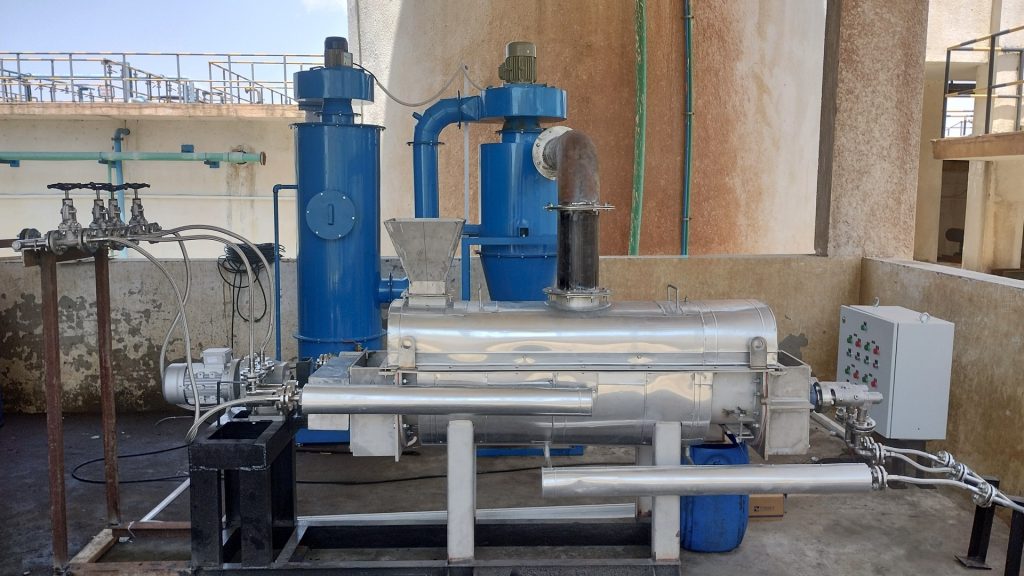
The SmarS® Paddle Dryer is a continuous sludge drying system designed for efficient and uniform drying. It consists of a rotating heated spindle and operates using steam as well as thermic fluid. Its design maximizes the heat transfer area to process volume ratio, ensuring uniform drying performance.

With its large processing capacity, fast drying speed, and low energy consumption, the SmarS® Paddle Dryer helps reduce production costs, sludge disposal costs, and manpower requirements while supporting environmentally friendly operations.
Key Features

Paddle Dryer Features
  • Optimized design developed using CFD Analysis.
  • Lowest steam consumption.
  • High thermal efficiency.
  • High heat transfer area to process volume ratio.
  • Self-cleaning mechanism.
  • Continuous and non-stop operation.
  • Controlled process for odorless and dust-free operation.
  • Wide range of sludge handling capabilities.
  • Easy to operate and requires minimal attention.
  • Available in SS 304/SS 316 construction.
2. SmarS® Belt Dryer

The SmarS® Belt Dryer is a closed-loop, low-temperature sludge drying system engineered to reduce the moisture content of dewatered sewage sludge using advanced heat pump technology. By recovering low-grade heat through a refrigeration-based heat pump, the system operates at temperatures between 40°C and 80°C, significantly reducing energy consumption and emissions compared to conventional high-temperature dryers.

The system combines a belt dryer configuration with a refrigeration-based heat pump to enable continuous sludge drying within an enclosed chamber. It is ideally suited for wastewater treatment plants pursuing sustainable sludge management, reduced disposal costs, and improved resource recovery.

Working Principle:
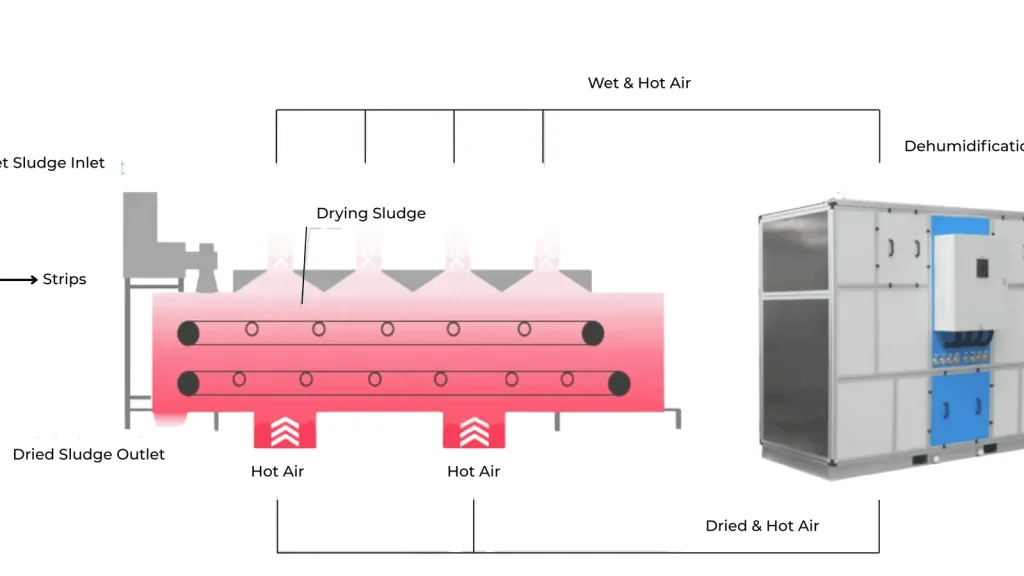
  • Sludge Handling: Dewatered sludge, typically containing 20–25% dry solids, is uniformly distributed onto a porous conveyor belt. The belt slowly transports the sludge through the enclosed drying chamber.
  • Heat Pump Operation: The heat pump extracts ambient or waste heat and upgrades it to a higher temperature. Heated air is circulated within the drying chamber. Moisture-laden air is cooled in the evaporator, condensing water vapor and recovering latent heat. The recovered heat is recycled to the condenser, maintaining a closed-loop drying cycle.
  • Drying Process: Hot, dry air gently evaporates moisture without causing thermal degradation. A final dry solids content of 65–90% can be achieved, depending on process parameters.
Belt Dryer Features
  • Closed-loop insulation system with thermal energy recycling to greatly reduce dehydration power consumption.
  • Low-temperature operation at 40°C–80°C (drying temperature of 65–75°C).
  • Low-temperature heat sterilizes and stabilizes bacteria in dried sludge.
  • Automatic control system with variable frequency gear motors.
  • Adjustable drying time and speed.
  • Closed-loop air circuit that minimizes odor emissions and heat loss.
  • Low operating temperature that prevents sludge oxidation and organic matter degradation.
  • Modular design for easy integration and scalability for existing facilities.
  • Automation with minimal operator intervention and real-time process control.
  • Latent heat recovery and efficient refrigeration to reduce overall energy demand.
  • Reduced carbon footprint through lower CO₂ emissions due to reduced thermal energy demand.
  • Volume reduction of 70–80%, lowering transport and disposal costs.
  • Resource recovery, with dried sludge suitable for further processing such as co-incineration, composting, or use in construction additives.

Technical Specification

Parameter

Details

Steam Consumption

Lowest steam consumption

Drying Process

Indirect drying process

Thermal Efficiency

High thermal efficiency

Heat Transfer

High heat transfer area to process volume ratio

Cleaning Mechanism

Self-cleaning system

Operation

Continuous and non-stop operation

Odour Control

Odour Control

Accessories

Supplied with complete accessories

Material of Construction (MOC)

SS304 / SS316

Sludge Handling

Suitable for wide range of sludge handling

Ease of Use

Easy to operate

Attention Requirement

Requires minimal supervision and attention

Get a Quote for Air Diffusers

Tell us about your requirements and we’ll provide the best solution for your aeration needs.

Get a Quote for SmarS® Paddle & Belt Dryer